

The Pasteurization Debate
If you've done any research on human donor milk, you've probably come across some version of the pasteurization debate. It tends to live alongside raw food movements and ancestral health discussions, and honestly, the people asking those questions aren't wrong to ask. They care about what's going into their baby's body. That matters.
So let's get into it, with the science actually on the table.
Nothing replicates the original
Mother's own milk, fresh and direct from the source, is the biological gold standard. It is the most bioactive form of human milk that exists — a full, living matrix of immune factors, hormones, enzymes, and protective proteins calibrated specifically for that baby, in that moment, by that mother's body. No processing step fully replicates that. We'll say it again and again, because parents deserve honesty over marketing spin.
What's also true: when mother's own milk isn't available, donated breast milk that has been responsibly screened, pooled, and pasteurized is the next best option. The American Academy of Pediatrics says so. HMBANA says so. Neonatologists across the country say so. And the research backs them up.
The real question isn't pasteurization versus some ideal raw alternative. It's what pasteurization actually preserves, what it changes, and why it becomes non-negotiable the moment milk is being pooled from multiple donors.
The process of pasteurization
The gold standard used by human milk banks is called Holder pasteurization (HoP). Milk is heated to 62.5°C and held there for 30 minutes, then rapidly cooled. That temperature and duration were chosen carefully — hot enough to eliminate the bacteria and pathogens that make pooled donor milk risky, gentle enough to preserve most of milk's nutritional and biological value.
The safety record is clear. After routine Holder pasteurization, 93% of donor milk samples showed no growth on routine bacterial cultures, even in milk that before processing tested positive for a range of organisms including Staphylococcus aureus and gram-negative rods.7 Almost all pathogens that may be present in donated breast milk can be inactivated by the Holder method.9
More is preserved than you think
This is where pasteurization critics often miss the fuller picture. Heat does affect some components of milk. But substantially more survives than is commonly assumed, and what survives is clinically meaningful.
Human milk oligosaccharides (HMOs)
HMOs are among the most studied components of breast milk — complex sugars that act as prebiotics, feeding beneficial gut bacteria and protecting against pathogens. Research analyzing HMO profiles before and after processing found that both Holder pasteurization and freeze-drying left HMO patterns in donor milks unchanged.1 These prebiotic compounds come through intact.
Macronutrients
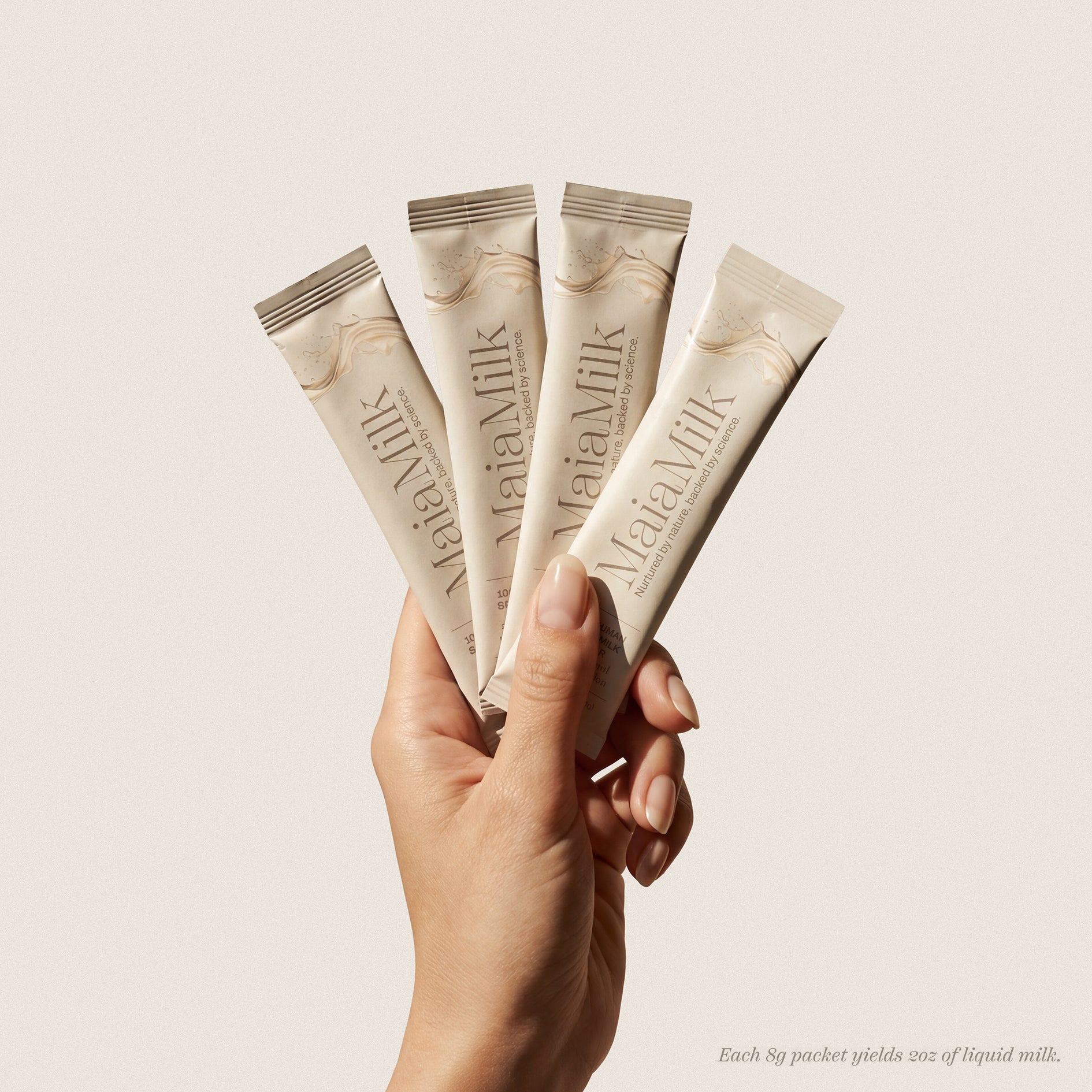
Proteins, fats, carbohydrates, calories — the core nutritional building blocks — come through pasteurization without meaningful loss. Studies confirm that freezing and Holder pasteurization produce no significant effects on macronutrient concentrations in human milk.3 This is precisely what makes it possible to analyze donated breast milk for a guaranteed nutritional profile and why MaiaMilk can stand behind every packet's composition.
Immune components
This is where the picture gets more nuanced, and it's worth being direct about it. The Holder method retains all lysozyme activity and does not destroy interleukins, though lactoferrin activity and total IgA are reduced compared to raw milk.6 Pasteurized donated breast milk is not immunologically equivalent to fresh mother's milk. But clinical practice across decades of neonatal care demonstrates that many of the beneficial properties of donor milk persist after Holder pasteurization.2
Fatty acids
Including the long-chain polyunsaturated fats DHA and ARA that are critical for brain and eye development, fatty acids survive the process without meaningful degradation. Carbohydrates including lactose and oligosaccharides, and lipids including ARA and DHA, appear unaffected by Holder pasteurization.4
The trade-offs
Some heat-sensitive components do take a hit, and pretending otherwise would undermine everything else in this post.
Lactoferrin, an important antimicrobial iron-binding protein, is significantly reduced by Holder pasteurization — the mean lactoferrin content before and after processing drops substantially, though lysozyme fares better.3 Bioactive proteins including hepatocyte growth factor and lipase can be reduced considerably by thermal processing.5
It's also worth acknowledging something that rarely gets said: even routine breast milk storage degrades bioactive compounds over time. Refrigeration, freezing, repeated freeze-thaw cycles — all of these affect immunoglobulins and other sensitive molecules in all breast milk, regardless of how it was processed. The longer milk is stored, the more molecular die-off occurs. This is simply the reality of how donated milk travels from donor to family, and it applies to every format on the market.
 This is real, and it's the reason active research into alternative preservation methods — high-pressure processing, HTST systems, freeze-drying in combination with other techniques — continues to advance. Science doesn't stay still, and the field is working toward methods that maintain safety while better preserving bioactivity.
But those alternatives aren't ready to serve families at home today with the safety assurances that matter. Holder pasteurization remains the evidence-based standard, and it is far safer than unpasteurized pooled donated milk.
Why this matters for donor milk
Here's the piece that often goes missing in raw milk conversations: mother's own milk and pooled donated raw milk carry fundamentally different risks.
When a mother feeds her own fresh milk to her own baby, both bodies are already in biological dialogue. She's producing antibodies calibrated to their shared environment. The milk is fresh, untransported, free of other donors' contributions.
Pooled donated breast milk is a different context entirely. It comes from multiple donors, collected at home, transported, stored, and combined before it ever reaches a processing facility. Before pasteurization, the majority of pooled donor milk samples grow at least one lactose-fermenting gram-negative rod, and most are colonized with Staphylococcus — often multiple organisms per pool.7 Pooling milk from multiple donors actually helps here, balancing and diluting concentrations of potentially problematic agents before pasteurization makes the process even more effective.9
Pasteurization isn't a compromise of human milk's value. It is the mechanism that makes donated breast milk safe enough to give to infants — particularly premature and medically fragile babies whose immune systems are simply not equipped to handle what an unscreened, unpasteurized product might carry.
Pasteurized donor milk is not a lesser version of human milk. It is a safer version of donated human milk — one that makes the human milk revolution possible for every family, not just those with direct access to a healthy, lactating mother.
What MaiaMilk delivers
What we can tell you with certainty about MaiaMilk is this: every packet is produced from clinically screened donors, processed by experts who verify the nutritional profile of each batch, and tested to guarantee a consistent makeup of calories, fats, carbohydrates, and protein. That consistency is not something most donor milk products can offer — it requires the infrastructure, the volume, and the rigor to actually measure and verify every batch rather than assume uniformity.
Whatever does survive the full handling and processing journey — and research into pasteurized and freeze-dried donor milk confirms HMOs come through intact1 — it still represents something that no manufactured formula can offer: a product that starts as human milk. Formula contains zero human content. The gap between a processed human milk product and formula is not a small one, even accounting for everything that changes along the way.
For families supplementing or bridging, that difference is the whole point.
The short version
Mother's own milk holds the top of the hierarchy, and it always will. Holder pasteurization makes the second-best option safe enough to use, without dismantling what makes donated breast milk worth giving. It is the responsible stewardship of something extraordinary, in a context where that something has to travel a supply chain before it reaches your baby.
The era of human milk is here. Pasteurization is what makes it accessible.
