

Traveling With Breast Milk: What TSA Actually Allows
Most of the stress of flying with breast milk is not the flying. It is the ninety seconds at the checkpoint where you are not sure whether the officer in front of you knows the policy.
So here is the policy, in the plainest terms available, straight from TSA.
Breast milk is a medically necessary liquid
That single classification is what everything else follows from.
Formula, breast milk, toddler drinks, and baby food in quantities greater than 3.4 ounces are allowed in carry-on baggage and do not need to fit within a quart-sized bag. The 3-1-1 rule does not apply to you.
There is no published container size limit and no published count limit. Officers do exercise judgment about what constitutes a reasonable quantity for your trip, so a stash sized to your actual travel makes for a smoother line than an unexplained cooler.
Your baby does not need to be there
This is the provision most parents do not know exists, and the one most often gotten wrong at the checkpoint.
Your child or infant does not need to be present or traveling with you to bring breast milk, formula, or related supplies. A parent flying solo on a work trip has exactly the same rights as a parent flying with the baby in a carrier.
A parent flying solo on a work trip has exactly the same rights as a parent flying with the baby in a carrier.
Ice packs count, even when they have melted
Ice packs, freezer packs, frozen gel packs, and other cooling accessories are allowed in carry-ons regardless of whether breast milk is present. Liquid-filled teethers are covered too.
Partially frozen or slushy is fine. It is subject to the same screening, not to disposal.
What screening actually looks like
Tell the officer at the beginning of the process that you are carrying these items in quantities over 3.4 ounces. Do not wait to be asked.
Remove them from your carry-on for separate screening.
Officers may need to test the liquids for explosives or concealed prohibited items. One line from TSA worth holding onto: screening will never include placing anything into the medically necessary liquid.
Clear translucent bottles make this faster. Milk in plastic bags or pouches often cannot be read by bottle liquid scanners, so you may be asked to open them for an alternate method such as explosive trace detection or vapor analysis.
You can also decline. If you do not want your milk X-rayed or opened, tell the officer. Additional steps will be taken instead, which means you and your other carry-on items go through enhanced screening.
If you want to sort any of this out before you are standing in line, TSA Cares takes questions ahead of travel at (855) 787-2227. They ask for 72 hours notice.
If an officer tells you something different
It happens often enough that Congress has now legislated on it twice.
A 2016 law established breast milk and formula as medically necessary liquids. Parents kept running into problems anyway, because officers were not consistently trained on it. So in November 2025, the Bottles and Breastfeeding Equipment Screening Enhancement Act was signed into law, passing both chambers unanimously.
What it requires: TSA must issue and maintain guidance to minimize contamination risk when milk is re-screened, developed in consultation with nationally recognized maternal health organizations, and updated every five years. It also requires officer training and clearer communication of parents' rights at checkpoints. The DHS Inspector General is directed to audit compliance.
In plain terms, hygienic handling is no longer a courtesy. It is a statutory obligation.
Practical protection anyway: have the TSA page saved on your phone before you leave for the airport. Not to argue with anyone. Just to hand over.
The version of this trip where none of it applies
There is one scenario where the cooler, the ice packs, the screening conversation, and the melting timeline all disappear.
When the milk is a powder, it is not a liquid.
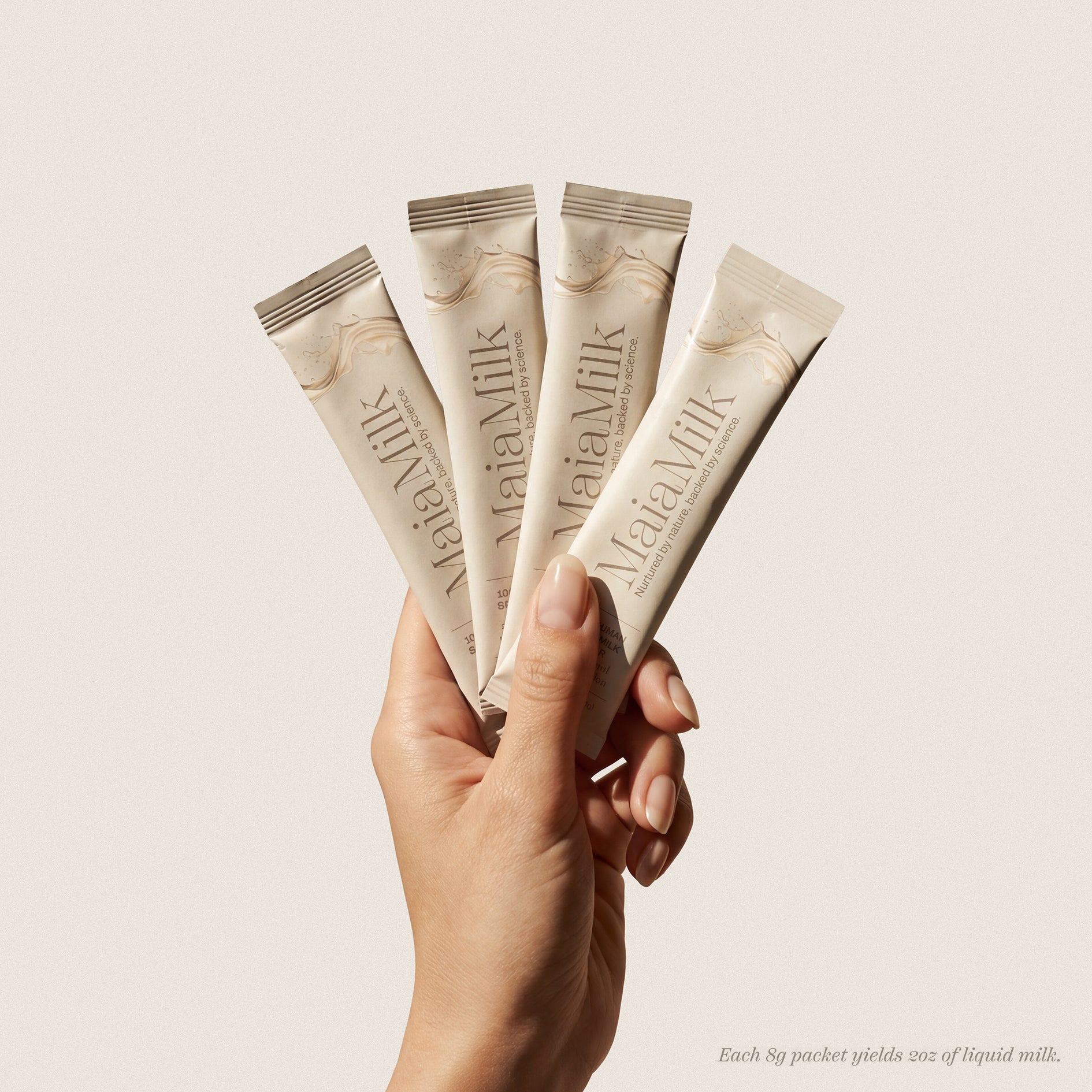
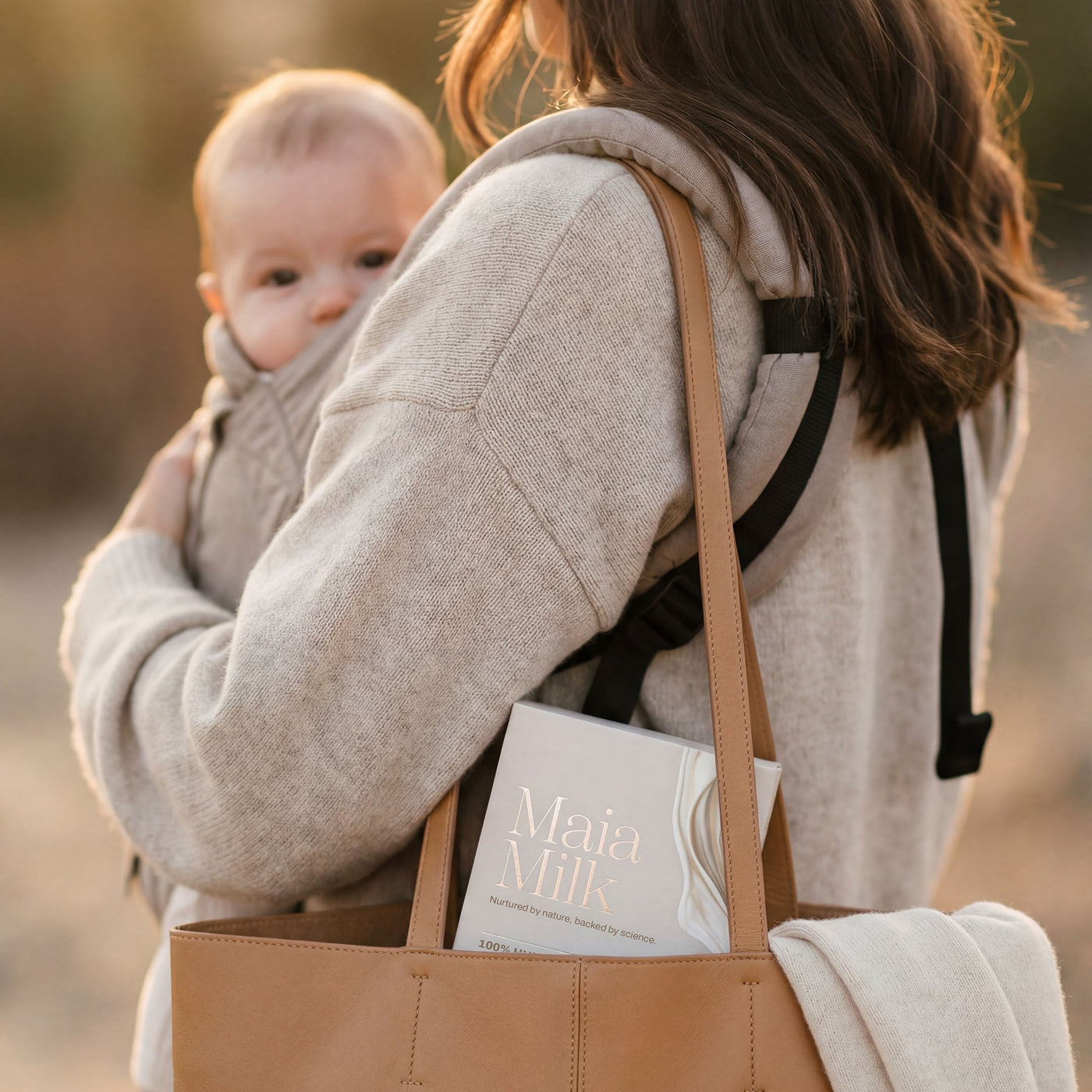
MaiaMilk packets are shelf-stable and mix with water, so the feeding plan for a travel day fits in a pocket. No cooler. No ice. No countdown from the moment you leave the house.
That does not replace what is in your cooler, and it is not meant to. It is one of several situations families plan around. But for the leg of the trip where keeping milk cold is genuinely not possible, it is worth knowing the option exists.
How long your milk keeps while you are in transit
Getting through security is one problem. Keeping milk cold across a travel day is a different one.
CDC's guidelines for freshly expressed breast milk: up to 4 hours at room temperature of 77F or colder, up to 4 days in the refrigerator, within 6 months in the freezer for best quality and up to 12 months acceptable. An insulated cooler with ice packs holds it for roughly 24 hours, which is the number that matters on a travel day.
Milk that has been thawed is stricter: 1 to 2 hours at room temperature, 24 hours in the fridge, and never refrozen.
Policies change. Check before you fly.
Everything above was verified against TSA and CDC guidance at the time of writing. Screening procedures get revised, and the 2025 law specifically requires TSA to update its guidance periodically, so some details will shift.
Before any trip, check tsa.gov directly. Treat this post as orientation, not as the final word on the day you travel.
Before you go
Save the TSA breast milk page to your phone.
Tell the officer at the start, not when they reach the cooler.
Pack milk where you can pull it out without unpacking everything.
Clear bottles over pouches where you have the choice.
Know that you can decline X-ray screening, that TSA Cares can answer questions in advance, and that you do not need your baby with you to exercise any of this.
